25 Cats, 7,000 Miles
Why Fly So Far?
Moving cats roughly 7,000 miles initially struck Mye Hoang as extreme. A lifelong cat owner, she knew about animals finding homes in the United States after being brought from conflict areas or disaster zones. But the work of Katy McHugh, a flight attendant and owner of Milwaukee’s Sip & Purr Cat Cafe, made her reconsider what could justify such a journey. McHugh’s plan was to collaborate with rescuers in Qatar and fly 25 cats to Milwaukee. The cafe supplied the crucial next step: somewhere to shelter the animals and introduce them to potential adopters. The flight was part of a route towards a home, not the rescue’s entire purpose.
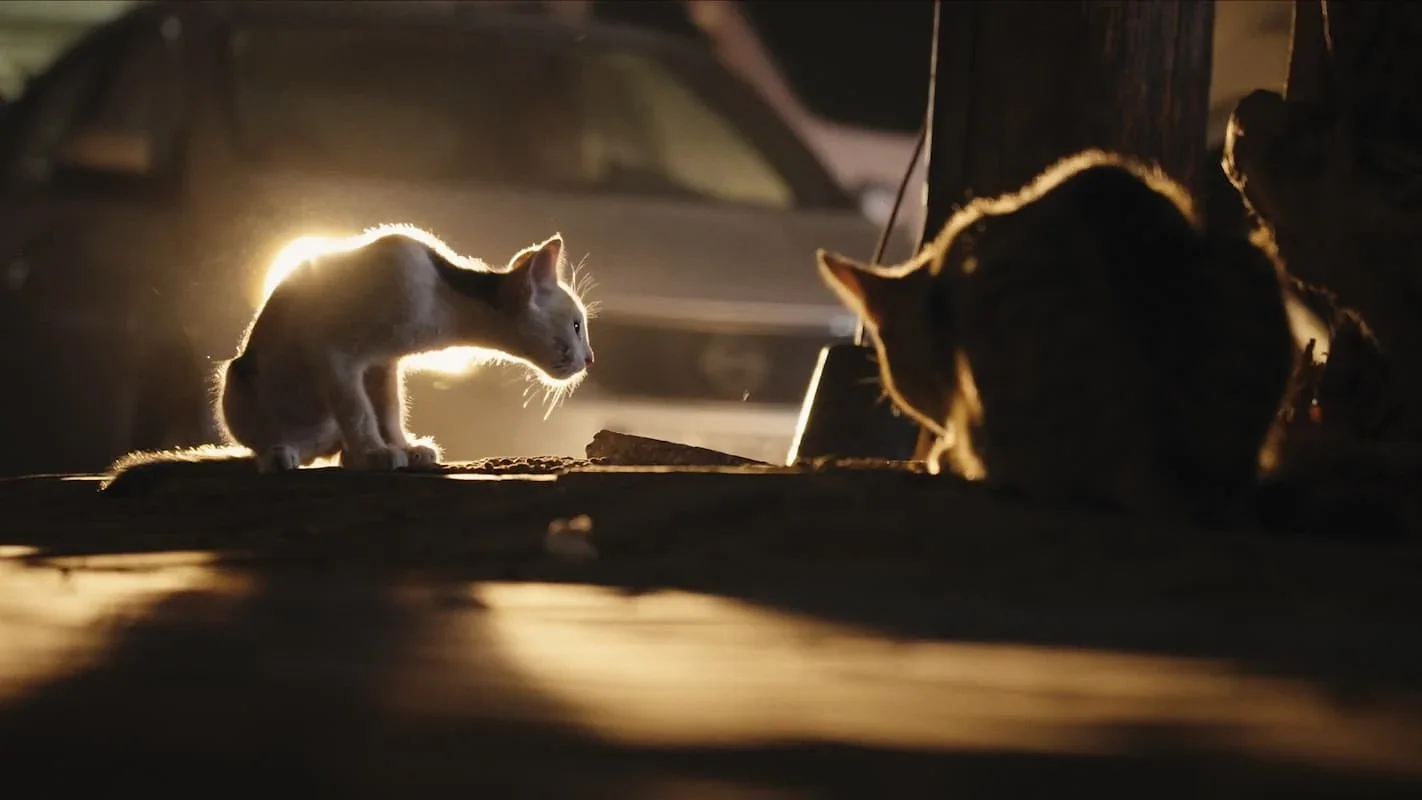
That disparity between distance and capacity gives 25 Cats From Qatar its central question: why undertake so much for so few? Hoang’s 2025 documentary, listed at 95 minutes by Savoy Lumière, follows a deliberately bounded mission. The filmmakers describe street cats facing extreme heat and disease, and rescuers unable to obtain the support they need locally. UWM Post’s Milwaukee reporting identifies migrant workers among those helping McHugh. Twenty-five places cannot answer the whole welfare problem described by these accounts. They can, however, reveal how people connect an urgent need in one city with an opportunity for adoption in another.
From Festival to Film
The project began with the circulation of another film. Recalling the encounter on The Projection Booth, Hoang describes McHugh attending a Cat Daddies screening at the Milwaukee Film Festival. Hoang visited the cafe, and they remained in contact. Curiosity came later, as she followed McHugh’s posts and began to understand the personal commitment involved. As Hoang understood it, McHugh was paying for the trips herself and transporting animals on commercial flights. That differed sharply from the large organisations and chartered aircraft the director associated with international animal rescue. An acquaintance became a documentary subject when the practical details challenged her assumptions.
Hoang places this discovery within her own move towards documentary. Frustrated by the difficulties of making narrative films, she had tried a form she had not originally expected to pursue and found it suited her. She asked McHugh whether she would participate in a film if funding could be found; McHugh agreed. An admirer of Cat Daddies subsequently offered an opening to discuss another project, and Hoang floated the rescue idea. Her recollection describes the proposal taking shape, rather than a completed financing arrangement. The important continuity is the relationship: making and showing one film created the contact through which another became imaginable.
Four Days, 25 Places
For Hoang, preparation was not material to hurry past on the way to departure. Her director’s statement describes concentrating on the practical work of a mission unfolding over four days, including the painstaking selection of 25 cats. She believed that showing this work fully could make it moving. Asian Movie Pulse’s review locates the resulting pressure in limited resources, health precautions and the ceiling on transport capacity. Those constraints make the countdown more than a race to leave: the rescuers must prepare animals for an overseas journey while confronting the fact that the available places cannot accommodate every need.
The review describes cats with dental infections or missing eyes, details that resist the reassuring shorthand of an appealing animal awaiting a loving owner. Care has to begin before adoption becomes possible. UWM Post likewise emphasises McHugh navigating obstacles to identify cats suited for adoption. Together, these accounts suggest that the dramatic weight lies in decisions as much as movement. The number in the title is a goal, but also a limit. Hoang’s description of the mission as unsanctioned adds to its precarious framing; it does not, by itself, establish that the rescue was illegal.
Beyond the Cute Cats
Asian Movie Pulse finds a darker edge here than in Cat Daddies, without describing a film emptied of hope. Its account identifies rescuers from the United States, Pakistan, Jordan, Singapore, India and the Philippines. The critic reads their cooperation as an opportunity for cross-cultural understanding; UWM Post stresses emotional engagement and responsibility towards stray animals. These are different interpretations of a shared practical foundation. McHugh is not operating in an empty landscape: the overseas journey depends on a multinational network already working with the cats in Doha. Compassion becomes useful through coordination, not simply through one person’s determination.
The review also praises the composed images of Qatar and its cats, and the atmospheric score. The production credits give those observations a precise footing: Robert E. Bennett is director of photography, Patrick Ouziel contributes additional photography, and Gil Talmi and Simon Wilson composed the original score. Hoang directs and edits. Ouziel’s portfolio confirms that distinction in photography roles. The advocacy therefore has a constructed cinematic form: images, music and the organisation of logistical work into a narrative all matter alongside the rescue itself. The critic’s praise concerns that treatment, not merely approval of the cause.
The Projection Booth’s programme description extends the reading to migration, class and labour. That is an interpretive frame, not a substitute for the rescuers’ individual experiences. Asian Movie Pulse, meanwhile, notes that Qatar appears through beautiful locations and compassionate people as well as suffering animals. This matters to the film’s central question: the country is not merely somewhere cats must leave. As the review describes, it is also where a multinational rescue network collaborates with McHugh to arrange the cats’ overseas transport.
Screenings That Support Rescue
After the rescue narrative, the film’s public life offers a concrete continuation of its appeal. UWM Post included it among the highlights of the 2025 Milwaukee Film Festival and reported Meowtel-sponsored travelling screenings intended to raise money and awareness for small cat rescues. Aurora Film Society subsequently advertised an April 18, 2026 screening at The Venue, presented with Meowtel to benefit Anderson Humane in South Elgin. That arrangement links the subject of the film to the purpose of the event: a story about creating an adoption route becomes an occasion to support another organisation providing animal care.
Savoy Lumière listed a May 3, 2026 screening, while The Projection Booth’s May 5 episode announced an Arab American Film Festival engagement at Cinema Detroit with a discussion featuring Hoang and McHugh. These are later screenings of the 2025 film, not a new production. The announcements do not establish attendance, adoption results or fundraising totals. What the benefit arrangements do establish is a practical connection: the work of finding homes for 25 cats can bring people together around a film, and organisers can direct that gathering towards supporting care beyond the animals on screen.