Hamnet: Preparing for the Unexpected
Ready to roll
In a Welsh forest, digital imaging technician Krzysztof Zawieja had to shrink his equipment. Cinematographer Łukasz Żal wanted maximum mobility; Chloé Zhao sometimes began filming without warning, catching moments with a documentary-like responsiveness. Zawieja rebuilt his setup to remain ready. His recollection raises the question running through Hamnet’s production: how does a carefully constructed period film leave room for people and landscapes to surprise it?
Novelist and co-screenwriter Maggie O’Farrell describes a corresponding act of trust: after reducing her book to a screenplay, she relied on the filmmakers and actors to restore its emotional detail. Zhao’s 2025 film imagines William Shakespeare and Agnes’s relationship around the loss of their son; it is fiction, not documentary. M+ identifies a Chinese-subtitled presentation, not a special cut or a Focus-branded programme. The film’s immediacy begins with preparation, rather than its absence.
Begin with the lovers
Speaking to Jalen Giovanni Jones for Electric Literature, O’Farrell traces her premise to a classroom discovery. As a teenage admirer of Hamlet, she learned that Shakespeare had lost an eleven-year-old son called Hamnet before writing the play. The similar names prompted her to imagine a connection between bereavement and creation. That is an imaginative starting point, not established historical causation. Research set limits: she visited the houses and resolved never to ignore a fact simply because it obstructed the story she wanted to tell.
Adaptation meant reducing 360 pages to a 90-page screenplay. Zhao chose the strands and dramatic beats; O’Farrell identified cuts that would leave later character motivations unexplained. Their methods differed as much as their responsibilities. Zhao thought aloud through voice notes, sometimes leaving a dozen or more notifications overnight; the longest message lasted 58 minutes. O’Farrell needed pen and paper to discover what she thought. Their collaboration balanced the film’s forward movement against connections that might disappear unnoticed until a later scene stopped making sense.
Chronology was the major reorientation. Rather than begin with the children’s illness and move between periods, the film starts with William and Agnes meeting. O’Farrell explains that repeated shifts would require ageing and de-ageing actors and continually signalling the time changes. Zhao wanted a different structure. Beginning with attraction allows the relationship to acquire its own history before loss tests it: viewers first encounter two people choosing each other, rather than a family already caught inside catastrophe.
Rooms and clothes speak
In Variety’s artisan panel report, Żal describes William’s early confinement through pressing ceilings, partitions and closed compositions. Set decorator Alice Felton gives that confinement material form. His father’s glove workshop contains sharp, threatening objects alongside beautiful workmanship: William is hurt there, and does not want to inherit the trade. Felton researched gloves at the Victoria and Albert Museum and commissioned reproductions at different manufacturing stages. The tools and unfinished goods make his unwanted future tangible, rather than merely furnishing a period workplace.
Costume designer Małgosia Turzańska recalls Cosprop finding an Elizabethan doublet among Victorian ball costumes in a box unopened for a century. The surviving non-royal garment informed William’s clothes. Agnes’s wardrobe follows a more expressive progression: vivid reds become rust tones during motherhood, then a scab-like grey-purple after Hamnet’s death, before recovering vitality in the finale. Felton describes a parallel subtraction in the parents’ bedroom, where orange-red bed drapes give way to a space stripped of colour after the loss.
Writing in The Asian Cut, critic Jericho Tadeo reads Agnes as an extension of nature, more at home in forest earth than within village restrictions. His account of Żal’s soft, expansive landscapes offers a counterpoint to William’s enclosed rooms. This is a critical interpretation, not evidence of the crew’s intentions, but it identifies how surroundings can distinguish the couple before either explains their feelings.
Keeping the camera free
That visual responsiveness required decisions before filming. In software vendor Pomfort’s interview, Zawieja explains that his previous collaboration with Żal on The Zone of Interest spared them an initial getting-acquainted period. They discussed cameras, formats, lenses and filters, then established the camera and colour pipeline with post-production studio HARBOR. Most filming used a single ARRI Alexa 35. Zawieja managed exposure, contrast, continuity and lens matching, allowing Żal to concentrate on composition rather than carry every technical demand himself.
Long-distance monitoring and camera communication kept Zawieja connected when the camera team moved farther away to capture nature. Data manager Carrie Cooksley subsequently linked his colour decisions with the original camera files and made three copies before shuttle drives went to the lab. Those linked decisions should not be confused with overwriting camera originals through monitoring corrections. Pomfort’s commercial context matters when reading the product praise; the practical contribution is a workflow that preserves image continuity and a dependable handover while the camera remains mobile.
Zawieja remembers Jessie Buckley performing Agnes’s loss with an intensity unlike anything he had witnessed on set. Casting director Nina Gold supplies another perspective: she recalls auditioning Jacobi Jupe roughly eight times and observing his repeated willingness to enter difficult emotions, including what he brought to the death scene. These are not accounts of the actors’ private methods. One records a crew member’s encounter with a performance; the other reveals sustained casting work behind the apparent immediacy.
A crowd meets Agnes
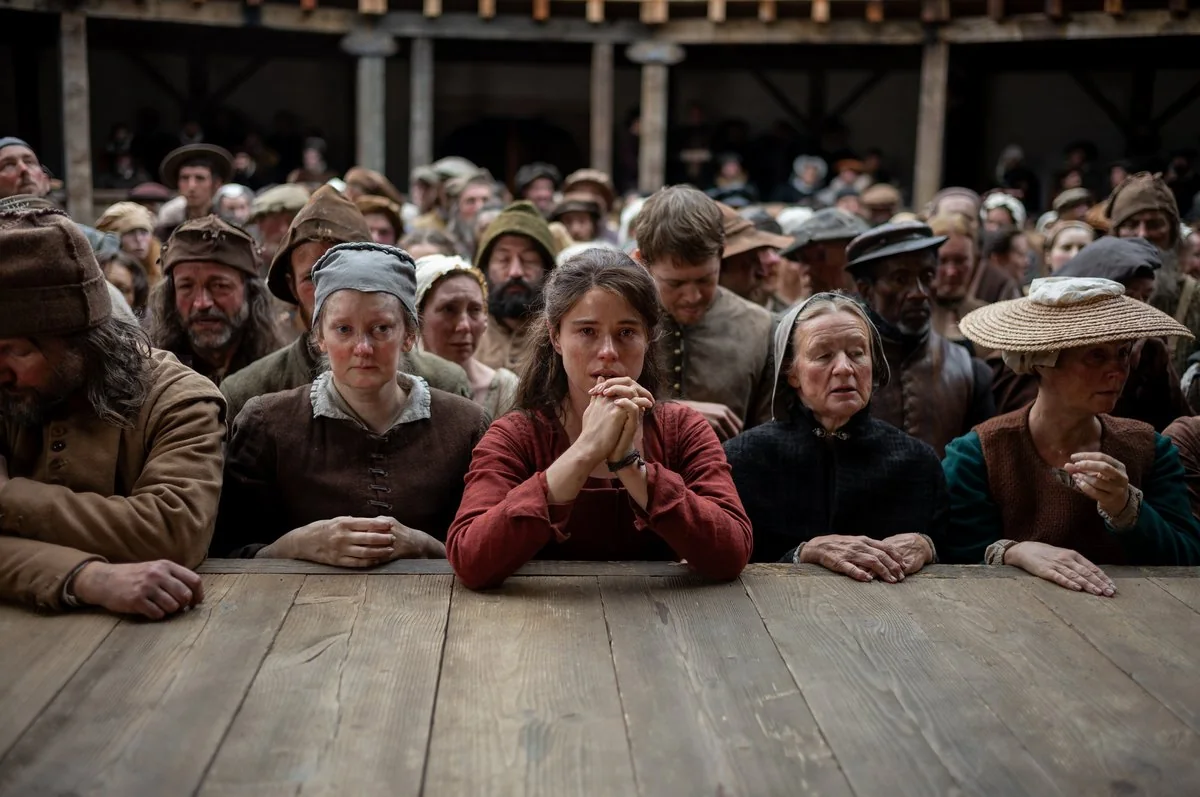
The finale brings the problem of interiority into public space. Novel readers can follow Agnes’s thoughts as she watches Hamlet; the screenplay brings her brother alongside her so part of that experience becomes conversation. O’Farrell identifies this as a practical adaptation solution. Another kind of preparation gave that conversation a world: Zawieja recalls the full-scale Globe replica built at London’s George Lucas Stage. A private reckoning could now unfold inside a physically constructed theatre.
Gold cast more than 350 extras, looking for faces without conspicuously modern features; Turzańska’s department dressed them all. The designer also identifies Zhao’s cameo, reaching a hand from the central balcony. These people are not simply historical decoration. In Tadeo’s reading, Agnes arrives resentful that her husband has used their dead son’s name before strangers, then discovers the crowd’s emotion. He interprets that recognition as a movement out of isolated grief: other spectators become part of her encounter with the play.
The film’s official account separately promoted Seth Rogen’s admiration for the third act’s boldness and emotional depth. That selected endorsement is publicity, distinct from Tadeo’s independent interpretation and the crew’s recollections. Together, these accounts describe construction, meaning and promotion—not a universal audience response. The ending places Agnes among others without establishing that every viewer will find the same release.
Beyond the theatre
Programmers have extended the invitation beyond watching. Reclaim The Frame advertised Liverpool printmaking, Belfast cyanotype and Cardiff quilting events alongside screenings, plus a prerecorded Q&A in Plymouth. These offered opportunities to make and discuss, rather than documented therapeutic outcomes. In Hong Kong, M+ listed screenings on 6, 14 and 15 February 2026; HKIFF advertised an 11 February CineClub preview at Emperor Cinemas Plus+ Tai Wai. Universal’s separate captions announced a 12 March theatrical release without specifying a year.
Taiwan’s later National Film and Audiovisual Institute programme placed Hamnet alongside theatre-and-life films including Drive My Car and Vanya on 42nd Street. Its Chinese-subtitled DCP is listed at 126 minutes, against M+’s 125; the discrepancy does not establish an alternate cut of the 2025 film. These bookings offer something more concrete than a promise of healing: a place to watch together, sometimes with time to talk or make something afterwards.