The Shadow’s Edge: Beyond the Comeback
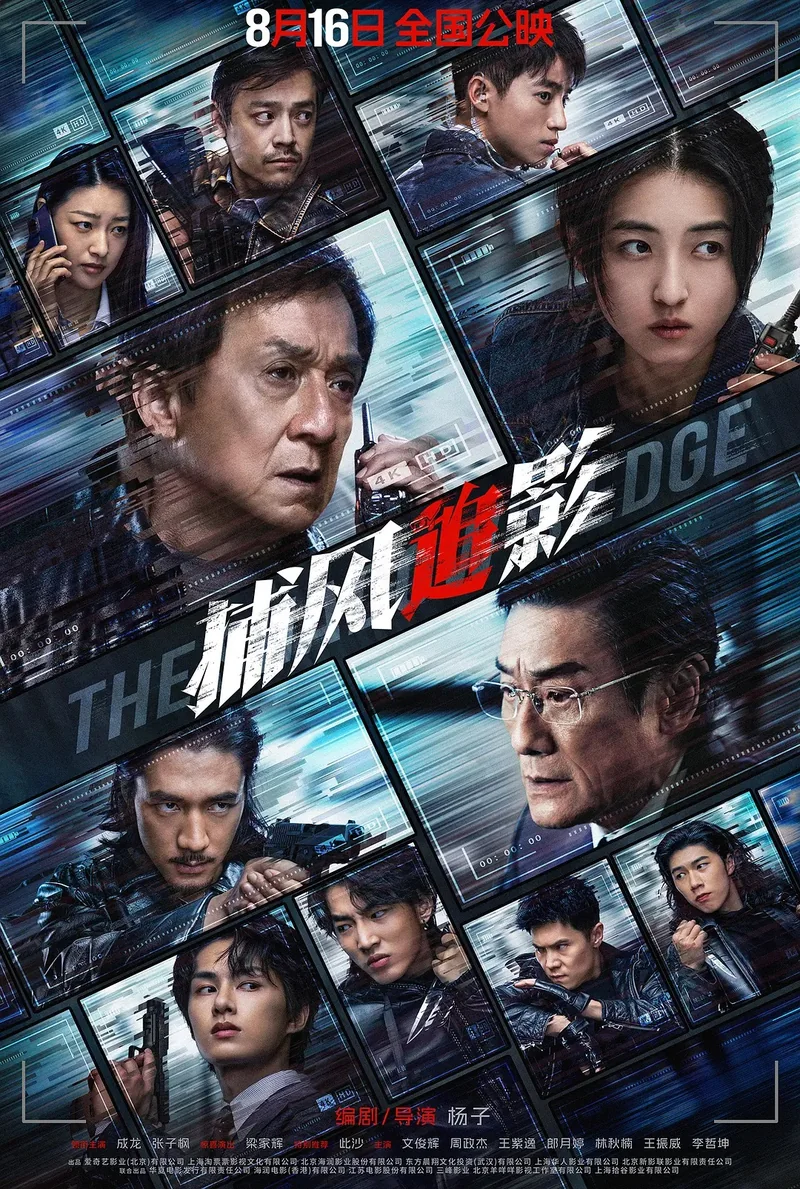
Another Cop, Another Chance
Jackie Chan did not immediately welcome another badge. In Naman Ramachandran’s Variety interview, published on 19 September 2025 and reproduced on KungFuMagazine’s forum, he recalled resisting another police role because he had played so many. Larry Yang’s presentation changed his mind: Chan saw a chance to bring something different to familiar territory. That hesitation is a more useful starting point for The Shadow’s Edge than a declaration of comeback. After their collaboration on Ride On, the question was not simply whether Chan could fight again, but what another veteran policeman could give him to perform.
“At first, I didn’t want to play another police officer because I’ve done so many cop stories,”
Jackie Chan · forum.kungfumagazine.com
This is Yang’s 2025 film, not a new 2026 production. The BBFC records a Mandarin-language UK 2D cinema version running 141 minutes 45 seconds, classified on 16 September 2025; Sino-Cinema lists 140 minutes. Those figures do not establish separate cuts. Neither record verifies the supplied TLKF2026/TKLF2026 presentation label, its local programme, screening language or subtitles. The later listing must therefore remain distinct from the production and the documented UK edition.
When Surveillance Fails
Sino-Cinema describes a loose reworking of Yau Nai-hoi’s Eye in the Sky, the 2007 surveillance thriller in which Tony Leung Ka-fai also played the villain. The update exchanges jewellery for cryptocurrency passwords and places hacked AI tracking between police and suspects. Its opening pursuit, described by the review as 17 minutes of action, moves from Macau Tower towards the Wynn Macau complex, with paragliding and rapid changes of masks and clothing. These are narrative manoeuvres: the system receives images without delivering reliable knowledge. Chan’s retired surveillance specialist becomes necessary because someone still has to interpret what the machines show.
For Sino-Cinema, moving beyond gadgetry towards traditional police work is a strength. John Lui’s Straits Times review sees the same technological collapse as a screenplay problem. A hacker who can defeat every supposedly secure system makes obstacles arbitrary; Lui asks why criminals possessing such valuable technology would bother robbing a casino. The disagreement is not about whether surveillance fails. It is whether that failure creates room for human ingenuity or gives the writers an unlimited escape route. The spectacular opening has to carry that burden of credibility as well as excitement.
The Pressure Behind the Blade
A more tangible pressure emerges in Chan Wai-fong’s 19 August report for Ta Kung Wen Wei. Leung recalled being given what he described as a real knife for a scene requiring him to stab towards Chan. Chan reassured him and urged him to relax; Leung admitted sweating when the take ended. The report does not identify the original interview or event, and the recollection establishes neither blade specifications nor safety procedures. What it does convey is the anxiety of making aggression convincing opposite a colleague. Chan praised Leung’s quick grasp of stunt-team instruction; Leung welcomed the opportunity to keep learning.
“I’m lucky to spar with an action superstar; with his teaching, I still have room to improve!”
Tony Leung Ka-fai · tkww.hk · translatedRead the original
能與動作巨星對打,這是我的幸運,在他的教學下,我還可以有進步的空間!
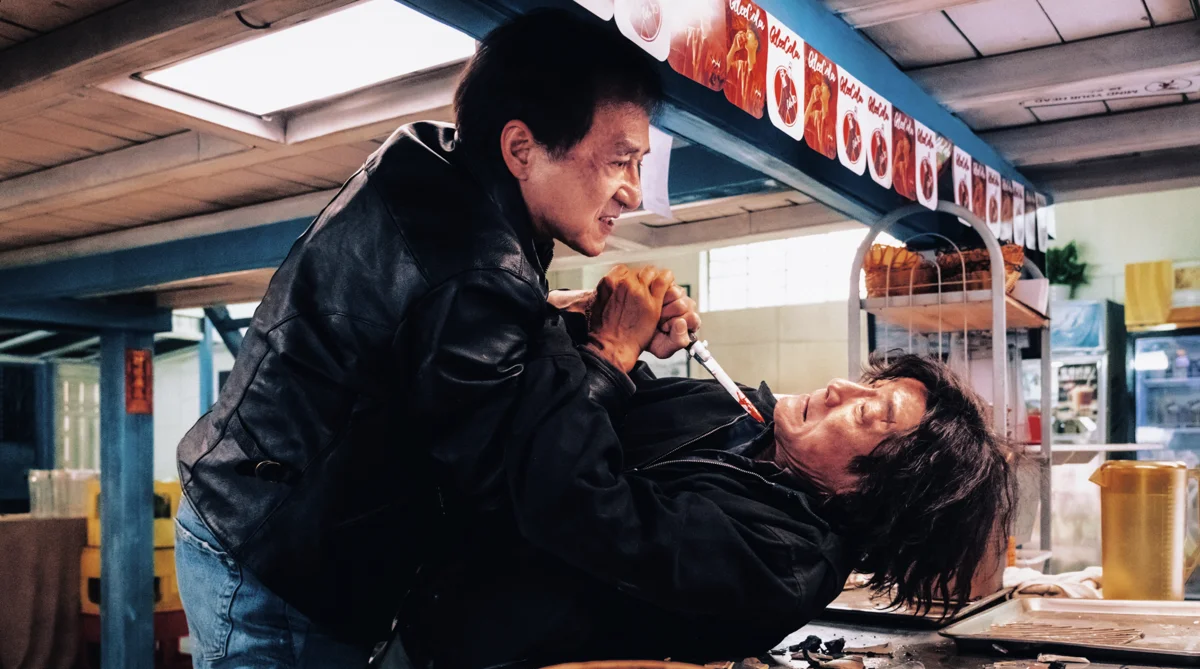
That exchange complicates any easy opposition between authentic bodies and artificial assistance. In the separately published Variety interview, Chan acknowledged that age and accumulated injuries had made some action difficult, while insisting technology should support rather than replace professional performers. Sino-Cinema credits Su Hang with action staging, Qian Tiantian with photography and Zhang Yibo with editing. Its assessment is that dark settings and nervous cutting make Chan convincing without requiring flashy stunts. Credibility, in this reading, is not an unaided feat: it is a collaboration between performance, staging, lighting and the cut.
Two Troubled Families
The younger characters give those bodies histories to carry. Sino-Cinema’s synopsis introduces He Qiuguo, played by Zhang Zifeng, as an operations-department number-cruncher who wants to become a detective. Chan’s character catches her following him and recognises the daughter of a colleague whose death his mistake caused. Her resentment makes their developing partnership more than an exchange of skills. Across the investigation, Leung’s mastermind struggles to control his adopted criminal family. One older man must rebuild trust after a failure; the other tries to preserve authority as loyalties fracture. Inheritance becomes a problem on both sides of the law.
Whether those relationships earn their screen time divides the critics. Sino-Cinema finds Zhang well cast as a prickly, resentful aspirant and sees the psychodrama as helping justify the long running time. Lui argues that surrogate-parent sentimentality bloats what could have been a tighter duel. Wen Junhui’s account offers a different, practical perspective on the generations working together. In the same Ta Kung Wen Wei report, he describes anxiety and excitement at acting with his childhood idol, crediting Chan and the crew’s encouragement with helping him commit fully. The speaking occasion is unspecified; the experience is his, not evidence that the family drama succeeds.
A Revival, or Too Much?
The revival narrative arrived early. On 5 August, NetEase-hosted commentator Guangying Xintiandi presented the film as a possible breakthrough for Hong Kong-style action, tying its prospects to younger performers and a stunt-team successor behind the camera. Feng Xiaoxiao’s 4 August commentary, edited by Yimeng, similarly framed it as renewed hope for Hong Kong cinema. These were arguments, not proof of an industry turning point. Henderson Pictures’ promotion extended the theme: its caption for Zhang Yuan’s Bu Xi music video explicitly honoured action-film workers, making their labour part of the campaign’s appeal.
Actual responses resist a single verdict. In his 27 August forum post, GeneChing celebrated the film’s old-school Hong Kong energy, accepting implausible surveillance and disguises as the price of its momentum and escalating spectacle. Lui awarded two stars out of five; Sino-Cinema gave seven out of ten. GeneChing’s pleasure and Lui’s impatience are especially revealing because excess matters to both. One enjoys the eruption into siege-scale mayhem; the other finds fights prolonged and poorly integrated. Neither response can stand in for an audience consensus.
That debate belongs to the 2025 release cycle. Lui’s 13 August review announced a Singapore opening on 16 August; Chan Wai-fong’s report announced Hong Kong for 11 September. Henderson’s matching schedule is promotional repetition, not independent verification. The reproduced Variety article also reported a Busan Open Cinema selection, without establishing Chan’s attendance or a festival interview. None of these milestones identifies the later 2026 local presentation.
An Actor Before an Icon
Chan’s own ambition is less tidy than reclaiming an action crown. In the Variety interview, he wanted recognition as an actor whose abilities include action, rather than someone defined entirely by it. He also recalled Yang returning with a new outline within two months of finishing their previous film. His account places the renewed collaboration in a shared appetite for work, not merely nostalgia. The challenge was to find another use for an experienced performer whose physical possibilities were changing.
Sino-Cinema finds an answer in Chan’s quieter exchanges with Zhang and in a tense lift encounter bringing the three leads together: presence and relationships can generate pressure without a monumental stunt. Lui finds the dramatic expansion unsuccessful, so that answer remains contested. The durable interest of The Shadow’s Edge lies in this unresolved balance. Bodily skill still matters, but so do the actor’s capacity to carry regret, a partner’s trust and the machinery that shapes their encounter. Chan’s return to the badge tests how those elements can work together, not whether one ageing body can rescue an industry.