How a Piano Breathes
Freedom on Record
Rachmaninoff talks, stops and starts again. Recalling a private recording of the composer playing his Symphonic Dances, director Jan Schmidt-Garre told BR-KLASSIK that its freedom astonished him. To his ears, the playing sounded improvisatory, better than on any other Rachmaninoff recording he knew; the interruptions made the scene unusually alive. Pianist Francesco Piemontesi had introduced him to it. Their question became how such an atmosphere and way of playing could arise—not simply how someone could master the notes. That distinction gives The Alchemy of the Piano, Schmidt-Garre’s 90-minute documentary from 2024, its starting point: virtuosity encountered in the midst of conversation rather than presented as a sealed, finished achievement.
The recording’s history requires a distinction between discovery and publication. Publicity calls it unreleased, but Salvatore Sclafani’s ResMusica review, reproduced by producer PARS Media and citing the accompanying booklet, says Ward Marston restored it and released it in 2018. Recorded in 1940, it captures Rachmaninoff singing and commenting beside conductor Eugene Ormandy. The available account does not establish when Piemontesi first heard it. The film’s dates also belong to different stages: Prime Video’s 2025 label and Naxos copyright concern its distribution listing, not a replacement for the original 2024 production year or evidence of a different cut.
Shaping the Search
The project grew from a friendship, not a roster of eminent interviewees. In Christian Schuler’s BR-KLASSIK interview, Schmidt-Garre recalled conversations with Piemontesi about subjects they felt ordinary music coverage neglected: a pianist’s breathing and hand position, rather than only interpretations or Beethoven. An early visit took them to Piemontesi’s mentor Alfred Brendel in London, followed by encounters with other musicians. Yet BR’s synopsis places Brendel at the conclusion. The difference matters: the sequence in which an inquiry develops need not be the sequence that best communicates it. A mentor encountered early can become the destination of the finished film.
Dated performance material supplies a few chronological anchors: Kars and Piemontesi in Paray-le-Monial in April 2023, Pires in Ribadeo that August, and Jaho with Piemontesi in Berlin in November. These are not a complete shooting log. BR, a co-producer, later announced a theatrical opening on 14 November 2024. Sclafani, drawing on the booklet, reports that unexpected encounters helped shape the project, making the final edit decisive. Sarah J. Levine’s editing credit therefore sits beside a particular structural challenge: organising discoveries that had not all been planned, rather than merely assembling a succession of musician portraits.
Breath, Body and Sound
The body makes the title’s alchemy concrete. Schmidt-Garre remembered Maria João Pires explaining how pianists work with their bodies; Sclafani emphasises her attention to the physical sensation of gesture and freedom of movement. In Max Nyffeler’s Frankfurter Allgemeine review, also reproduced by PARS, the underlying puzzle is mechanical: how can a hammer-driven, essentially percussive instrument communicate human thought and feeling through fingertip contact? Pires shifts attention from isolated fingers to the moving person at the keyboard. Expression, on this account, cannot be considered separately from the physical action that produces the sound.
Imagined sound provides another route. Nyffeler describes Antonio Pappano using Puccini’s Che gelida manina to demonstrate how a simple sequence of notes becomes an expressive melody, then exploring melodic qualities in Chopin’s G-minor Ballade. Pappano advocates imagining orchestral colours at the piano. In the critic’s account of soprano Ermonela Jaho, legato connects to the wish that something should never end; a very high pianissimo begins with imagining breath rather than material sound. The demonstrations offer different working images: an orchestral palette, an unbroken line, a trace of air. Translating them into piano playing remains a task, not an automatic consequence of understanding the metaphor.
For Jean-Rodolphe Kars, inner imagery draws explicitly on faith. He left his piano career and was ordained a priest at 39. Nyffeler reports that, during Piemontesi’s visit to a Burgundian monastery, Kars associates Fauré’s First Nocturne with the First Epistle of John and its proclamation of eternal life. This is one performer’s way into the music, not a universal explanation of Fauré. Alongside Pires’s movement and Jaho’s imagined breath, the example gives the investigation specificity: musicians may seek colour and continuity through resources that are bodily, vocal or religious, without those resources becoming interchangeable.
A Staged Return
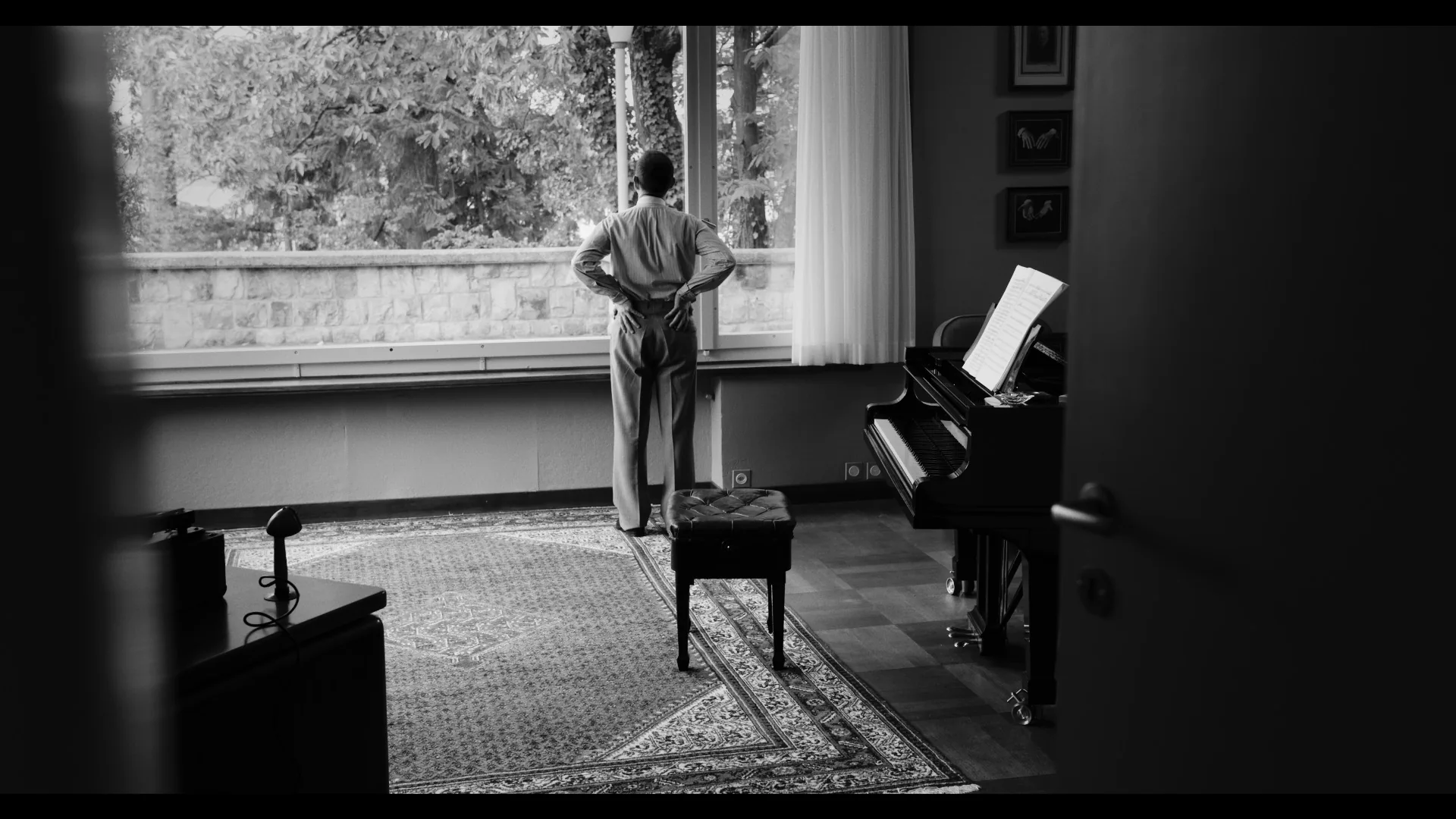
Cinema faces a related translation problem: how to give visible presence to a musician who cannot be interviewed. Nyffeler describes the noisy historical acetate recording serving as the original soundtrack to a reconstructed scene. Sclafani identifies pianist Eldar Nebolsin portraying Rachmaninoff at Villa Senar, the Swiss estate the composer built in the 1930s; the cast credit confirms his role. The images are staged, not recovered footage of the recording session. That distinction defines the device: the voice and playing survive historically, while a present-day performer supplies a body through which the recorded encounter can be pictured.
Villa Senar also contains Rachmaninoff’s own Steinway. Sclafani describes it as the centre of conversations involving Piemontesi, Yulianna Avdeeva and Zlata Chochieva. Here musical transmission has a material anchor: an instrument available to living musicians, rather than only a sound preserved on disc. The critic separately discusses bonus video and audio performances on that piano, including Chochieva playing Rachmaninoff transcriptions; these should not be confused with scenes in the feature. The surviving instrument and the reconstructed figure offer different kinds of proximity, neither of which can simply hand over its former owner’s musical imagination.
The Unexplained Spark
Schmidt-Garre’s stated interest in alchemy is the joining of material and spiritual experience. BR’s promotional framework gives that ambition six headings: body with Pires, sound with Stephen Kovacevich, images with Kars, voice with Jaho, colours with Pappano and form with Brendel. This is a map of the film, not proof that playing consists of six separable ingredients. Indeed, the broadcaster describes Rachmaninoff as ultimately overturning those divisions. The director’s intention and the broadcaster’s organising scheme meet here, but do different jobs: one establishes the question, the other offers routes through it.
Nyffeler reads the film as an inquiry whose increasingly precise observations leave something beyond conscious intention and explanation. He locates that limit in the closing Rachmaninoff quotation against black: good playing contains a momentary, inexplicable spark that makes a work live. This does not invalidate Pires’s bodily awareness, Pappano’s imagined colours or Jaho’s breath. It separates conditions musicians can cultivate from a result they cannot guarantee. The opening recording’s talking, restarting and freedom make that distinction audible: a performance can be intensely alive without presenting itself as a flawless object, and its vitality need not yield a repeatable formula.