Love in Fuyuko’s Quiet World
Beyond the beloved book
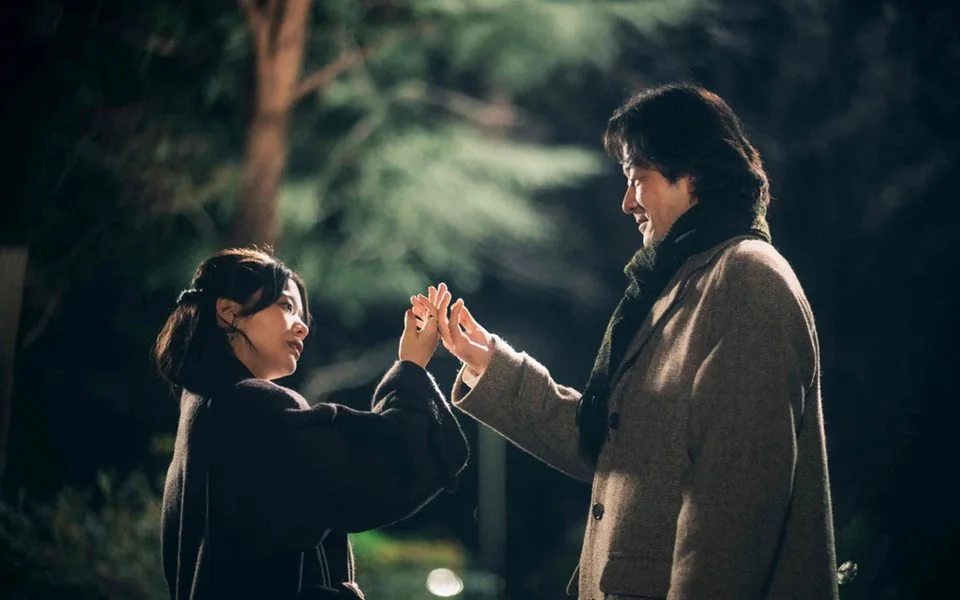
For Yukino Kishii, loving the novel made playing Fuyuko harder. At the November 1, 2026 post-screening event at the 39th Tokyo International Film Festival, she recalled reading Mieko Kawakami’s book when it appeared, then returning to it repeatedly. In Cinema Factory’s officially supplied event account, she explained that those readings had accumulated into a private history for Fuyuko. Encountering the screenplay exposed how firmly that history had settled. Simply reproducing her beloved character would not necessarily make a film. With writer-director Yukiko Sode, she had to construct someone new.
“I felt that simply tracing and reproducing it would not make it work as a film.”
Yukino Kishii · cinema-factory.jp · translatedRead the original
ただなぞって再現するだけでは映画として立ち上がらないと思いました。
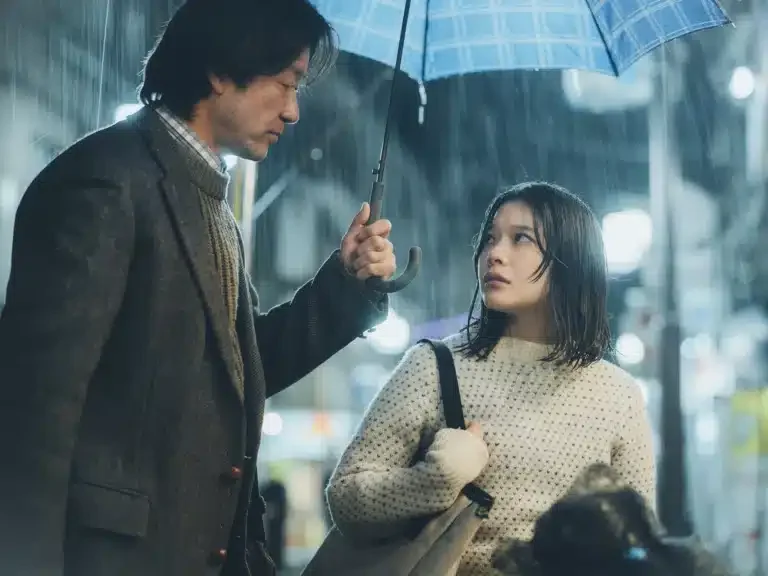
Sode’s All the Lovers in the Night is a 139-minute adaptation produced in 2026, listed in Hong Kong as 東京夜旅戀人. Kishii plays a freelance proofreader accustomed to solitude; Tadanobu Asano is Mitsutsuka, the reserved physics teacher she meets at a culture centre. SEMINCI’s synopsis describes their subsequent café meetings as a gradual, fragile connection between people who do not readily disclose what they carry. That progression gives the adaptation its particular task: making an inward change perceptible when the person experiencing it has little practice in sharing herself. The Spanish festival lists Japan and France as the production countries, while distributor Bitters End lists Japan.
Between actor and character
Kishii had discussed the rebuilding on a separate occasion: the Japanese-media press huddle after the May 17 Cannes screening, also documented in an officially supplied Cinema Factory report. Sode, she said, combined their respective images of Fuyuko when differences between novel and film left her struggling. Asano likewise arrived with his own conception of Mitsutsuka, then found the director drawing him towards hers through discussion. In Tokyo, he qualified his memory: specific techniques now escaped him, but he remembered working through his interpretation of the script and its difficulties with Sode. Both accounts locate the work in negotiation rather than solitary preparation.
“She talked things through with me, and we built it together.”
Tadanobu Asano · cinema-factory.jp · translatedRead the original
きちんと話をしてくれて、一緒に創り上げてくれました
Misato Morita offered a colleague’s view in Tokyo. She first met Kishii on this production, where her intense concentration seemed to fit Fuyuko’s self-contained world. Meeting her again on a television drama one or two months later, Morita was startled by a much brighter presence. She understood the contrast as Kishii taking on each work’s colour without losing her own core. The recollection brings the preparation down to an everyday encounter: someone who thought she had met the actor discovered how much of that first impression belonged to the film.
Kishii appreciated almost the opposite quality in Morita. She described a steady presence, apparently able to move between herself and a role while remaining recognisably the same person. For Kishii, who acknowledged becoming deeply concentrated within a production, that continuity was reassuring. These reciprocal observations suggest two different working rhythms, not competing prescriptions for acting. Sode’s own memory of Kishii adds the production-wide dimension: with Fuyuko absent from almost no scene, she felt the actor had become a fellow combatant, present as the acting department’s leader as much as its star.
A friend notices
A friendship makes Fuyuko’s movement visible in a small exchange. Eiga Channel’s November 7 report describes a released scene in which she eats sushi with Hijiri, her friend and work associate, played by Morita. Hijiri has visited Koh Samui with a man who is not her boyfriend. Fuyuko wants to know why they are not dating and what kind of affection Hijiri feels. When Hijiri notices this unusual interest in romance and asks whether something has happened, Fuyuko denies it and looks away. Curiosity draws her into the conversation; recognition makes her retreat.
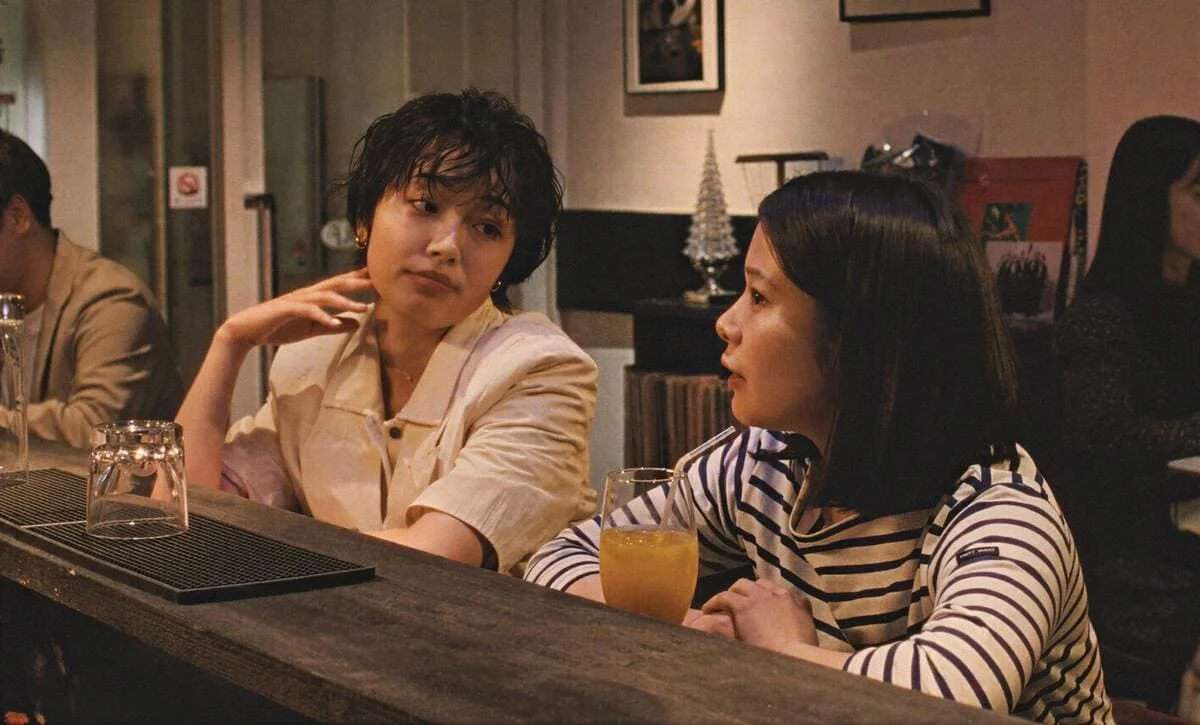
Yet Hijiri is more than the outspoken friend who exposes a quiet protagonist’s feelings. Sode’s Tokyo assessment was that Morita communicated Hijiri’s own hurt even during abusive speech, preventing the character from becoming merely difficult to like. Her related promotional comment published by Eiga Channel praised the different facets Morita brought to each appearance.
“Morita gave a nuanced performance without making a show of the character’s ugliness.”
Yukiko Sode · eigachannel.jp · translatedRead the original
森田さんは露悪的になることなく繊細に演じてくださいました。
Light and a separate voice
The adaptation also finds ways to retain the novel without keeping everything inside Fuyuko. Otocoto reported that 16mm photography was chosen in connection with the story’s emphasis on light, and that the film uses Chopin, whose music already matters in the book. Yasuyuki Sasaki is credited as cinematographer. These decisions give light and music a material place in the translation. The distributor’s digital presentation specifications do not contradict the reported film capture: they describe how the finished work is shown, rather than how its images were photographed.
The narration creates a more explicit separation. Sode explained in Tokyo that she wanted the beauty of Kawakami’s language but also distance from the protagonist, so chose a male voice: Tori Matsuzaka’s. Kawakami described the film as a beautiful translation that disclosed aspects of the story she had not discovered through writing or reading alone. To her, the narration resonated deeply with solitude and night, though she acknowledged that viewers could hear its place differently. Fidelity here did not mean making Fuyuko speak every retained passage; it meant finding another position from which the words could reach her story.
An unexpected laugh
At Cannes, the audience supplied an adjustment of its own. Kishii recalled French viewers laughing when Fuyuko and Mitsutsuka cannot read the dish names in a French restaurant—a response she found particularly fresh in that setting. Sode felt relief when passages she had considered comic in the editing room finally drew laughter; a Japanese industry screening had produced no such reaction. Asano described a different discovery. Mitsutsuka had remained unresolved for him, but watching alongside the audience gave him a feeling of arriving somewhere. For these participants, the premiere changed their relationship to work they had already completed.
Mirror Fiction’s April 16 headline centred Kawakami’s journey from little-known singer to international novelist and the Cannes selection. Later, Eiga Channel published a solicited recommendation from Ryusuke Hamaguchi, who admired Sode’s ability to make a film about light. The literary headline foregrounded the author; the filmmaker’s endorsement foregrounded a cinematic subject. Neither is an independent critical verdict, but their contrasting emphases sharpen the adaptation’s central tension: the book brings viewers towards the film, while the film needs to give them something they could not encounter on the page.
Closer to home
Those encounters are widening. The May world premiere at the 79th Cannes festival was followed by the Spanish-premiere listing in the 71st SEMINCI’s October Meeting Point programme, then the November 1 Japan premiere at the 39th TIFF. Japanese theatrical release is set for November 13. Hong Kong’s Play It Again records the 2026 film under its local title with a Film Centre 30 label, without specifying local screening dates. These are successive stops for Sode’s adaptation, not evidence of a separate Hong Kong edition.

One forthcoming stop brings the conversation nearer Sode’s beginnings. Nagano Aioiza Roxy has announced her appearances after its 10:00 and 15:20 screenings on November 28 in her home city. At Cannes, the director, now living in Kanazawa, said she wanted to challenge the assumption that making films requires remaining in Tokyo. She hoped filmmakers could live where they chose and turn those varied experiences into richer work.