Before the Eight Became Immortals
Eight mortals speak Cantonese
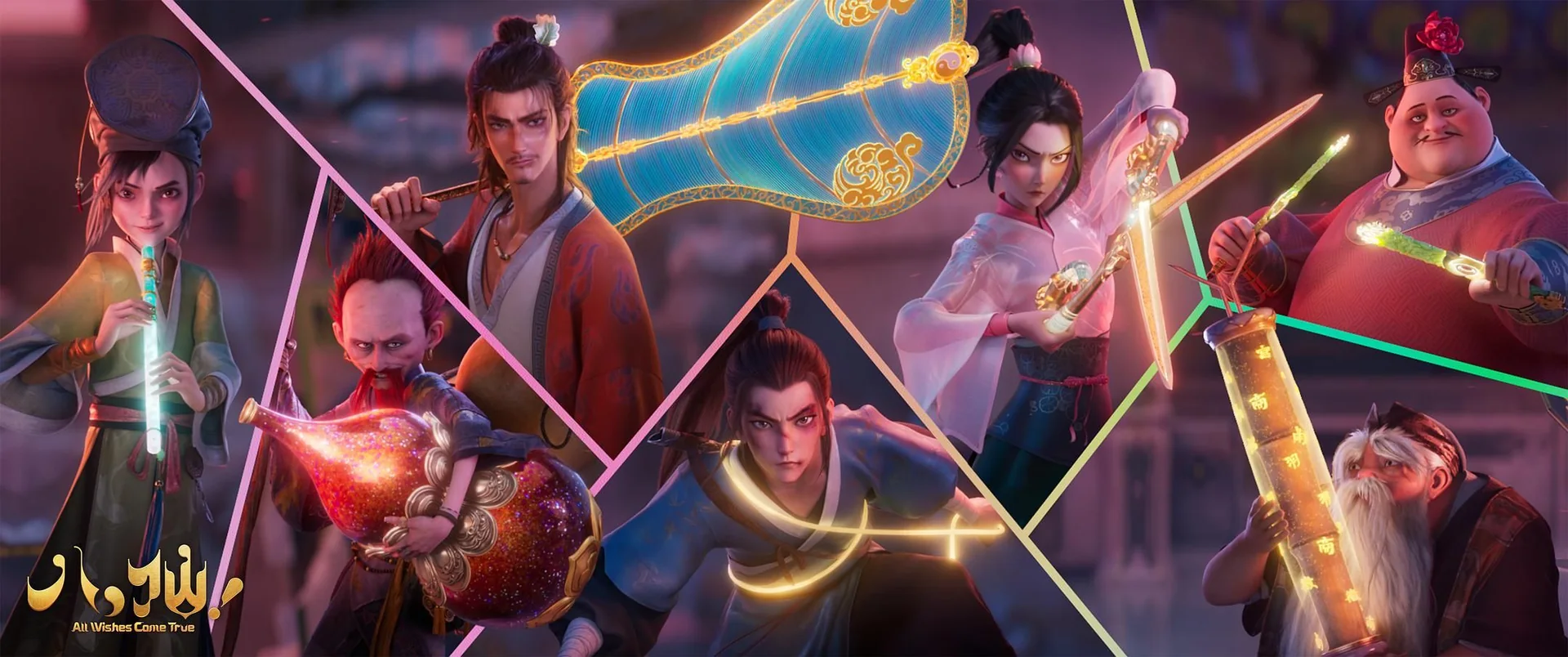
At the Hong Kong premiere on August 19, director Mu Zhengyang presented the Eight Immortals before their elevation: ordinary people willing to speak up for others. For the August 20 release, they also acquired local voices. Bastille Post reported that Mu personally selected the Cantonese voice actors and that the dialogue incorporated Hong Kong humour and slang. These choices fit the film’s premise: bringing revered figures closer means considering how they speak, not simply replacing one language with another. Whether the adapted jokes work is a separate question from the decision to localize them.
The editions need separating. CMC lists Mu’s All Wishes Come True! as a 143-minute Mandarin film with Chinese and English subtitles; the BBFC records a 2026 production and a UK cinema version lasting 143 minutes 16 seconds. Neither establishes the Cantonese edition’s exact runtime, voice cast or a Broadway booking. Elizabeth Kerr’s Kai-Fong review independently lists the August 20 Hong Kong opening, but credits Putonghua performers. Its judgments are not an assessment of the Cantonese performances.
Why rob the gods?
Why turn the Eight Immortals into a heist crew? In But Why Tho’s interview, Pearl Studio’s Catherine Ying located the opportunity in what familiar storytelling leaves open. The sea-crossing image presents immortals already equipped with magical objects; how they assembled, and why they needed to cross, offered room for invention. Mu’s account to Bastille Post supplies an ethical boundary for that freedom: he understands these figures as defenders of mortals, rather than beings entitled to divinity from birth.
The robbery makes that distinction practical. Lü Dongbin and Zhongli Quan recruit a team to impersonate immortals and enter a legendary vault containing gold and a lantern intended to protect the realm. Kerr reads mythology and heist mechanics as a particularly successful match. Douglas Davidson, writing at Elements of Madness, identifies a quieter structural choice: the opening narrator is a human affected by the lantern’s absence. Before divine power becomes spectacle, someone who must live with its consequences establishes the stakes.
Real bodies, impossible moves
Impossible movement began with specific action decisions. Speaking through a translator to Gene Ching, Mu credited Huang Chengxi with laying the initial action foundation. As the project’s demands grew, Su Hang supplied alternative designs for Mu to choose from. Animation, Mu explained, freed Su from live performers’ physical limitations. That freedom still involved selection: the proposals had to serve the director’s vision, rather than merely make each fight bigger.
Physical reference remained important. China.com’s August 21 report on a released making-of featurette describes Mu demonstrating expressions and gestures, staging fights with Su and the stunt team, and humming rhythms for composer Shen Bi’ang. These performances communicated character and timing to animators; reference filming does not itself establish motion capture or rotoscoping. Mu separately told Bastille Post that keyframes, camera movements and animation were crafted manually. That is production testimony, not an audited guarantee of an entirely AI-free pipeline.
The world draws on another kind of reference. A CGTN report republished by Bastille Post describes blue-green landscape aesthetics, glass-like gradients in celestial settings and transport inspired by Han murals. Kerr’s impression of painterly 3D animation is a separate critical response, not confirmation of every design influence. Technical ambition also requires precise wording: when Ching’s translated exchange suggested Chinese animation ranked first technologically, Pearl Studio CEO Catherine Yin corrected it to top tier. The concrete design choices are more revealing than a ranking.
Eight faces, unequal space
Keeping eight people distinct involved problems no magical design could remove. Mu recalled needing three youthful voices for Han Xiangzi: the first boy’s voice deepened before rerecording, and the second also matured before additional dialogue was needed. This is a production recollection, not a Cantonese casting story. Mu also described the difficulty of framing eight characters while preserving individual performances, even when only two or three drove the scene. An ensemble requires more than everyone fitting into the shot.
The solution included hierarchy. In But Why Tho, Mu acknowledged concentrating on two or three leads, with the others supporting them. Representative colours drawn from the Five Color Aesthetics approach, alongside deliberately contrasting voices, helped distinguish the characters. Recognition, however, is not the same as dramatic depth. Looking back on the finished film, Mu told Bastille Post that all eight ultimately felt like protagonists to him. The way the filmmakers distributed the scenes still leaves two or three characters with more room to develop.
He Xiangu exposes the trade-off. Producer Cao Linlin praised her independence and determination, citing a fight against seven older, stronger men. Kerr instead found her pursuit of the lantern inadequately motivated and her characterization thin; she also thought detours into Zhongli’s tragic past damaged the pacing. Davidson judged the ensemble more favourably, praising its deft handling. These evaluations ask different things of the film: a memorable fighter, comprehensible motives, or collective momentum. Success at one does not settle the others.
Beyond changing the dialogue
Can emotion carry unfamiliar mythology abroad? Yin told Ching that viewers need not already know Yang Jian: understanding his overwhelming power can suffice, with curiosity following attachment to the characters. Davidson’s experience complicates that confidence. He found fast dialogue and subtitles competing with the imagery for attention, while some mythological references remained unexplained. His observations concern the subtitled version he reviewed, not the Cantonese dub. Local slang addresses linguistic distance; unfamiliar relationships and mythological shorthand pose another challenge.
The announced rollout was broad, but its dates conflict. Cartoon Brew reported a July 18 China opening, August 13 in Australia and New Zealand, and August 14 in markets including Britain; the BBFC lists August 7 for Britain, an unresolved discrepancy. Yin recalled visiting more than 18 Chinese cities in July–August before US promotion, during which Ching interviewed the team on Labor Day. That establishes promotional activity, not global success. HustleBustle_China’s hit narrative and Chengdu’s box-office-and-local-industry branding likewise constitute promotional framing, not independently established reception.
What the sword passes on
The most revealing inheritance is smaller than a cinematic universe. Explaining the passing of a sword to Ching, Mu said Lü Dongbin already possessed standing, whereas Zhongli Quan needed acknowledgment after failure and recovery. The weapon recognizes someone rebuilding himself. The CGTN report republished by Bastille Post connects responsibility through Zhongli, Lü and He Xiangu, each inspiring the next. In a separate Bastille Post interview about the premiere, executive producer Ying Xujun recalled how the group reconciles over a pot of porridge. That scene gives the same ethic a domestic scale: repairing a group can mean feeding it, not defeating an enemy.
Mu’s favourites shift between interviews: Zhongli’s flawed resilience for Ching, Tieguai Li’s grounded humanity for Bastille Post. What persists is his interest in imperfect people. Kerr reads the film as choosing community over wealth; Mu hopes it prompts curiosity about traditional stories. Sequels remain conditional ambitions, as Yin acknowledged, rather than a secured universe. The stronger endpoint is the sword and the meal: recognition and care as things these mortals can pass on before they ever become gods.