Amour: Care Without Comfort
Learning the Wheelchair
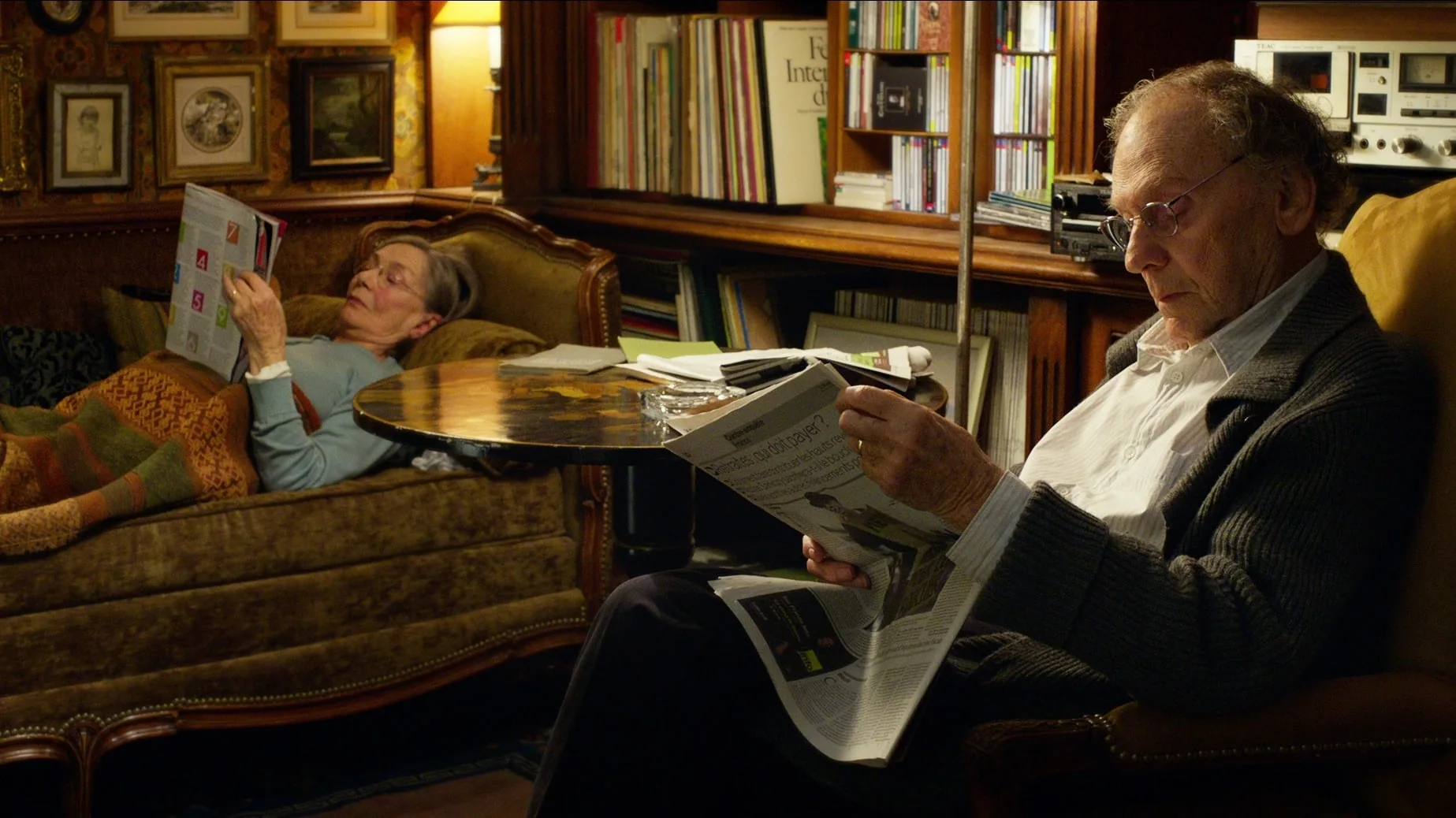
The electric wheelchair frightened Emmanuelle Riva more than inhabiting Anne. At the press conference reported by Brogen Hayes for Movies.ie, she recalled worrying that she would drive into a wall. Michael Haneke demonstrated the controls, circling around to show how manageable it was. Riva told the story with laughter: the practical apparatus of disability, rather than identification with a woman losing her independence, had been her greatest obstacle. It is an unexpectedly comic entry into Amour, Haneke’s 2012 French-language film starring Riva, Jean-Louis Trintignant and Isabelle Huppert.
Anne’s stroke transforms the retirement she shares with Georges in Paris. But Riva did not describe preparing a catalogue of suffering to make that transformation legible. She remembered no highly organised preparation; what mattered was confidence in Haneke and his instruction to avoid sentimentality. That direction clarified the task rather than diminishing it. When he found a moment unconvincing, she could recognise the problem herself. Her account locates authenticity in knowing when not to add more: Anne had to remain a person, not become an actress’s demonstration of distress. For a film about care, this is a consequential distinction. Emotional force need not depend on a performer signalling how much pity the character deserves.
Building a Shared Life
The question behind the film was personal, but the narrative was not a transcription. Speaking to Karin Schiefer in May 2012, Haneke traced its beginnings to confronting the death of someone loved within his family. In Sheila Roberts’s later press-day interview, he described the helplessness of watching a loved one suffer, then explicitly separated that catalyst from the screen story. The distinction matters: personal experience supplied the difficulty he wanted to explore, not a claim that Georges and Anne reproduce particular lives.
The apartment makes that conversion from memory to construction tangible. Its floor plan almost exactly followed his parents’ home, but the decoration was French. Colours developed from the reconstructed library; the furnishings mixed 1950s furniture, stereo components from the 1960s and a DVD player from the 2000s. These were accumulated possessions, not a uniform period look. Haneke wanted the rooms to register years of habitation rather than announce a set. That required fabrication: he described theatre and bus material before the studio work outside Paris, with window views also needing to be filmed convincingly.
“In any case it should look lived in and not like a studio.”
Michael Haneke · austrianfilms.com
The film’s public passage in 2012 moved from the Cannes Palme d’Or to an October 15 preview at the Cinémathèque française. Samya Yakoubaly’s event report places that screening within a Trintignant retrospective, ahead of the October 24 French release. A painstakingly constructed private household thus entered public view partly through a celebration of its leading actor’s career.
Trust Under Strain
Haneke’s working method left little room for spontaneous rewriting. He told Roberts there was no improvisation: experienced actors arrived prepared, movements were blocked, shooting began, and takes continued until the result satisfied him. His general rejection of rehearsal had a concrete exception. Riva practised with the wheelchair after shooting, over several days. Precision did not mean pretending that professional experience could solve every physical problem; the equipment demanded its own learning time.
“There is no adlibbing and no improvisation at all.”
Michael Haneke · collider.com
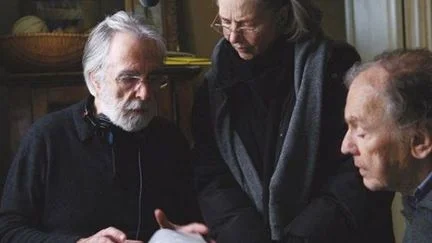
The actors did not describe that control in a single emotional register. Riva recalled close understanding and pleasure in becoming someone she no longer recognised as herself on screen. Huppert characterised the demanding work as reciprocal, with rewards matching the demands. Trintignant, returning to a major screen role after concentrating on theatre, spoke of pain alongside unusual pride in the result. These testimonies allow strain and satisfaction to coexist. None requires the comforting fiction that a successful performance must have been easy to produce.
The pigeon exposed control’s practical limit. Trintignant recalled two days filming an unpredictable bird against Haneke’s exact expectations. Haneke explained that seeds were laid out to encourage its route, leaving the unsteady actor to react physically. Their injury accounts differ: Trintignant mentioned a broken wrist and a fall; Haneke described a broken hand sustained with a physiotherapist, away from the set, which also complicated the suffocation scene. The accounts should not be fused into a claim that filming the pigeon caused the fracture. What both establish is that precise staging depended on a vulnerable body responding to something that would not take direction.
“I think there were two pigeons because one gave up!”
Jean-Louis Trintignant · movies.ie
Is Restraint Compassion?
Huppert resisted the suggestion that the daughter she plays is cruel. At Hayes’s conference, she placed cruelty in the situation itself, describing the daughter as movement entering a household brought to a halt. This makes the visits more than a test of whether a child cares sufficiently. Her continuing life collides with the couple’s suspension; the conflict emerges from incompatible conditions, not simply a deficient personality.
Critics disagreed over whether the film’s restraint makes such suffering accessible. Jacky Bornet’s Cannes review found emotional intensification in minimalist staging and devotion in the couple’s actions. Writing in Taiwan in 2015, 吳秀蘭 emphasised the labour of feeding, washing and rehabilitation, and the limits of endurance beneath it. Fabrice Sayag’s 2020 review instead found the fixed, exact frames cold and Trintignant’s and Huppert’s delivery more recited than inhabited. He admired Riva, yet read her commitment as troubling exposure. That last judgment describes his viewing experience, not evidence that overrides her account of trust.
Peter Conrad’s November 2012 interview essay identified a compassion newly visible in Haneke’s work. Haneke himself rejected the premise of a changed method when Roberts raised a similar question: the writer and director were the same; the subject differed. The disagreement is not settled by calling the film humane. Its exactness is precisely what one critic experiences as emotional concentration and another as exclusion.
Death Without a Verdict
The framing narrative removes death as a suspense mechanism. Haneke told Schiefer that announcing its certainty avoided a false narrative arc: a happy outcome was never a credible promise. Attention can instead fall on what happens before that certainty is reached. Yet he would not fix the pigeon’s significance, accepting interpretations without declaring it a symbol with one meaning. His explanation to Conrad—that spectators complete a film through thought—extends this refusal. Neither the announced death nor the openness of interpretation amounts to a definitive endorsement of euthanasia. The film’s construction asks for judgment without supplying a verdict that dissolves the difficulty.
“The audience completes the film by thinking about it; those who watch must not be just consumers ingesting spoon-fed images.”
Michael Haneke · theguardian.com
In January 2013, the setting changed to Remiremont, where Riva had first acted on stage as a teenager. Presenting Amour there, she said Anne had arrived at the right moment in her life and that she had immediately felt ready. But she resisted describing the role as a culmination: that sounded too much like being finished. Franceinfo’s report also records her fatigue after six months of promotion and her refusal to make awards the purpose of acting. After so much discussion of endings, Riva insisted on a distinction of her own. The role could be exceptional without becoming a final statement about the woman who played it.
“Awards aren't what we're here for. It's awkward to think about them beforehand.”
Emmanuelle Riva · franceinfo.fr · translatedRead the original
Les prix, on n'est pas là pour ça. C'est un embarras d'y penser avant