Before the Rain, Beyond the Golden Lion
A role before a meeting
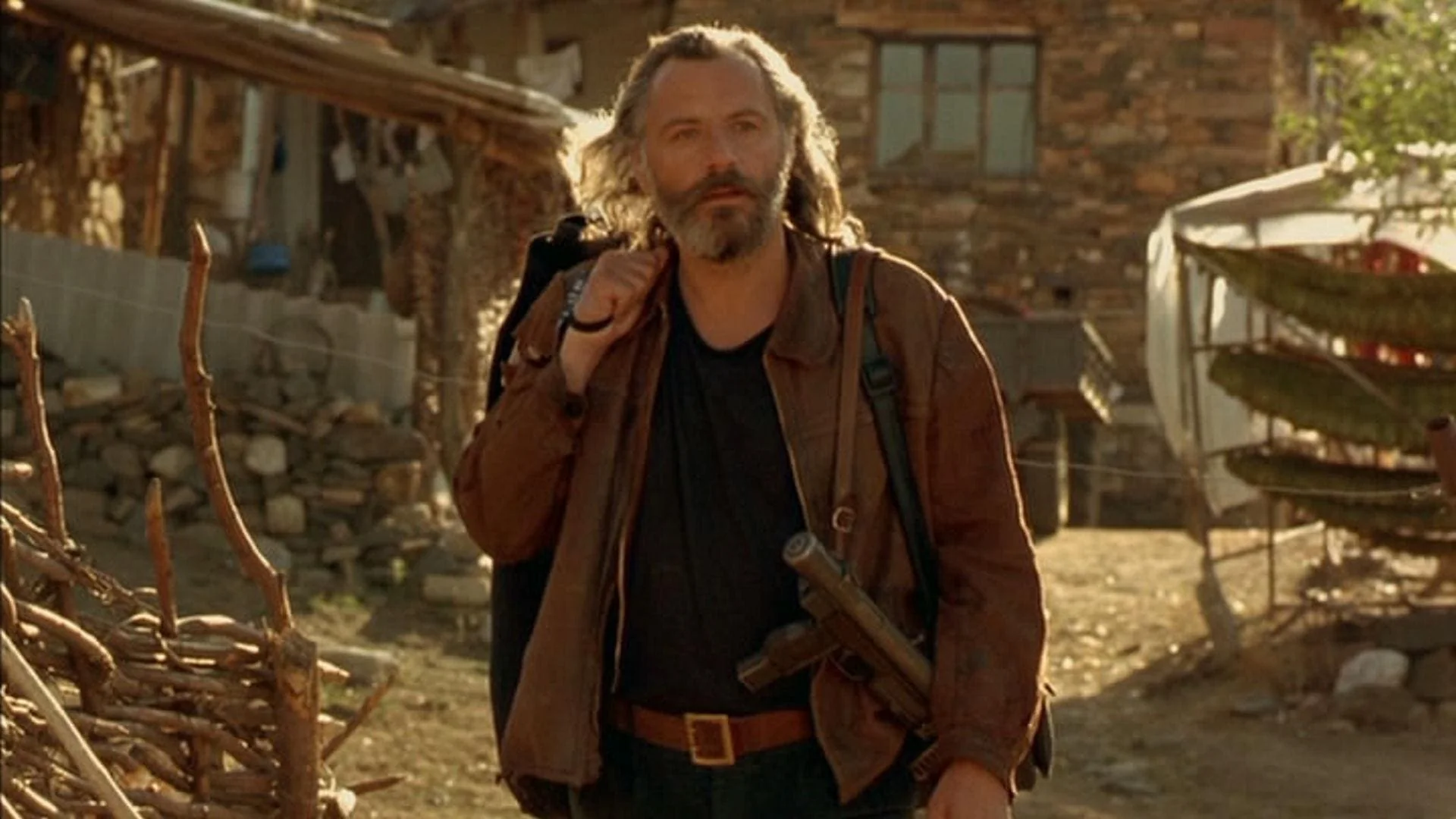
Before Rade Šerbedžija met Milcho Manchevski, the director already knew him through cinema. At the December 9, 2024 anniversary media meeting, reported by Racin, Šerbedžija recalled Manchevski finding him in London in 1992 and handing him the screenplay for Before the Rain in a Soho café. He read it twice that night. When Manchevski explained that he had written Aleksandar for him, the actor wondered how that was possible: they had not known each other. The answer lay in his performances for Živojin Pavlović, Manchevski’s favourite director. An earlier body of work had helped shape a character before their collaboration began.
At the Cinematheque’s December 2019 gathering, Šerbedžija had described the film as a lifeline during his London years. That recollection placed the conversation about the specially written role after casting; the later account foregrounded the café and screenplay. Their common point is the value he attached to being recognised through his work, rather than an exact casting timetable. Manchevski’s 1994 film brought him together with Katrin Cartlidge, Grégoire Colin and Labina Mitevska. A restored-copy gala was announced for Skopje in 2024, a later presentation of the original film. Neither a Hong Kong Broadway screening nor an edition for such a screening is verified.
“At that time, Before the Rain was a lifeline for me.”
Rade Šerbedžija · makfax.com.mk · translatedRead the original
Во тоа време ‘Пред дождот’ за мене беше спас.
Macedonia, London, Macedonia
The chapters run Words, Faces, Pictures. In Words, the silent monk Kiril shelters Zamira, an Albanian girl; their escape ends with her being shot by her own family. Faces moves to London, where photo editor Anne’s relationship with photographer Aleksandar intersects with her failing marriage. A restaurant shooting kills her husband. Pictures follows Aleksandar home to Macedonia, where his attempt to rescue Zamira ends in his death and sends her towards the monastery. Returning to the opening situation changes what shelter means: Kiril’s private act of protection now belongs to a chain of choices crossing households, communities and countries.
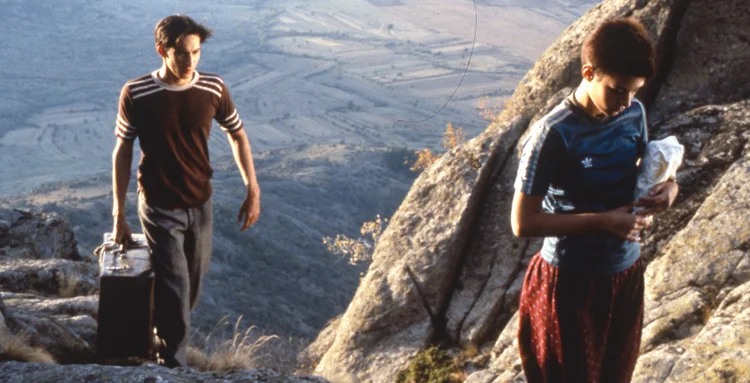
Aleksandar’s return also revises the photographer’s apparent distance from violence: he admits that a complaint about unexciting pictures prompted a militiaman to execute a prisoner. Looking is implicated in what happens. Writing for Tebok Kai in 2024, critic Ajla Medanhodzic emphasises the tight interiors, London’s intimate conversations and close-ups, and communication across Kiril and Zamira’s linguistic divide. She hears Anastasia’s mixture of church music, ethnic rhythms and modern composition as a link between segments. These are readings of the finished work, photographed by Manuel Teran and edited by Nicolas Gaster, rather than accounts of how particular shots were made.
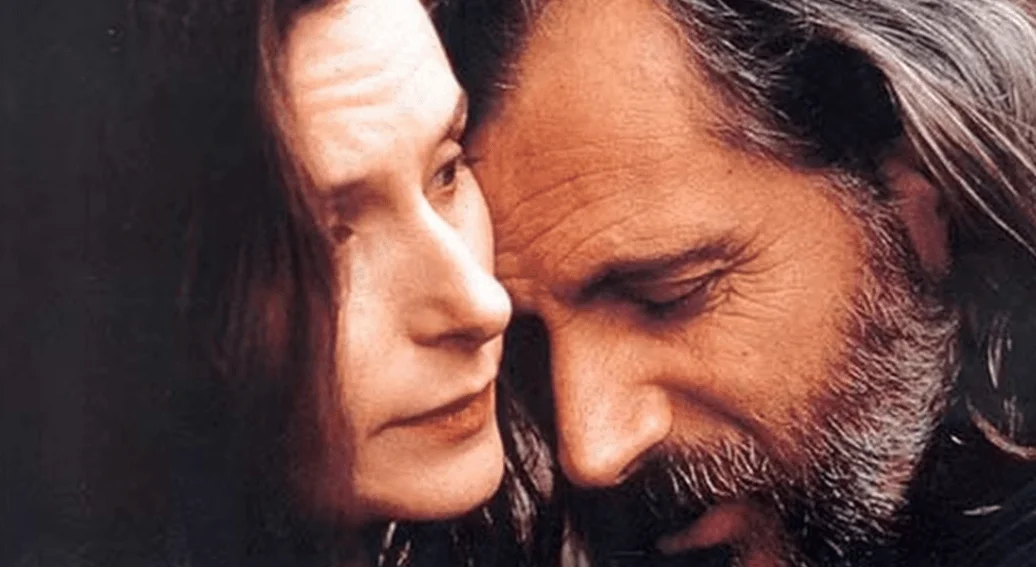
The geographical design offered another filmmaker a usable model. Interviewed around the 2019 Golden Horse festival, Takahisa Zeze said he initially considered adapting three stories for The Promised Land with an urban–rural contrast like Before the Rain’s Macedonia–London–Macedonia movement. Discussions with novelist Shuichi Yoshida changed that plan: Zeze added Tsumugi as a connecting character and arranged scenes of her working in Tokyo. This is influence at the level of a working problem: how separate stories and places can illuminate one another, rather than simply sit side by side.
What the cast remembers
The 2024 reunion also brought the discussion down from structure to an actor’s brief encounter. Katerina Kocevska remembered her delight at being cast and joked that, without becoming as famous as Šerbedžija, she could claim an almost-love scene with him—in which he rejected her. Suzana Kirandjiska recalled only a few shooting days, but remembered the cast and the atmosphere Manchevski created. These memories locate the production in small parts and short stretches of work, not only in the performances that became its public face.
“When they told me I had got the role, I was overjoyed.”
Katerina Kocevska · racin.mk · translatedRead the original
Кога ми соопштија дека сум ја добила улогата бев пресреќна.
Editor Nick Gaster remembered a productive contradiction: a harmonious crew drawn from across the former Yugoslavia and beyond was making a film about retreat into tribal division. His account counters treating the story’s hostilities as an inevitable description of the people making it. The collaboration was, in his recollection, an alternative social experience, with friendships lasting long after production. That does not dissolve the divisions dramatised on screen; it distinguishes the film’s subject from the relationships that enabled its telling.
Labina Mitevska, who made her debut as Zamira, supplies a less ceremonial view of a breakthrough. In Lejla Sabit’s 2021 Nezavisen interview, she expressed gratitude for Manchevski’s willingness to take a casting risk and trust her. Recognition, she explained, can secure an initial contact, but cannot substitute for another strong project or performance. Festivals, producers, funds and sales agents keep demanding results. The opening created by Before the Rain was real; her account resists turning it into a career that thereafter advanced automatically.
“Recognition helps with initial contact, but without a quality project or performance, you will quickly be forgotten.”
Labina Mitevska · nezavisen.mk · translatedRead the original
Препознатливоста помага за иницијален контакт, но ако не донесете квалитетен проект, квалитетна изведба, брзо ќе ве заборават.
A film becomes a national image
Manchevski’s own Venice memory turns international recognition into an identity farce. Speaking in 2019, he recalled returning from London to the 1994 festival under the assumed name Vasko Gonzalga so journalists would not discover that he was receiving an award. He said he did not know it was the Golden Lion until the ceremony began. The film shared that prize with Tsai Ming-liang’s Vive L’Amour. The remembered uncertainty matters: the national landmark was not experienced from the outset as a guaranteed triumph.
Critic Marina Kostova described nearly a decade of collecting the international response as documenting a young country’s emergence, not merely a film’s success. That archival impulse took material form in Rain, the 2004 collection edited by Kostova with Blagoja Kunovski, combining reproduced coverage with production letters and memos. Production designer David Munns offered a smaller-scale memory in 2024: people he met in Puglia in 2004 spontaneously recited dialogue when they learnt he had worked on the film. His anecdote describes a particular encounter, not a measurable worldwide response.
Celebratory framing can narrow what such recognition means. Crnobelo’s anniversary appreciation presented the film as an unsurpassed Macedonian achievement; the 2024 organisers linked it to statehood and national self-confidence. An opposing interpretation, attributed to Slavoj Žižek in Wikipedia’s summary of criticism, argues that it accommodates Western expectations of the Balkans as a place of recurring, primordial passions. That secondary-reported criticism is not production testimony, but it identifies the tension within national visibility: becoming internationally recognisable also raises the question of which image travels.
Keeping the film available
Inheritance also requires something more concrete than praise. In 2019, Cinematheque director Vladimir Angelov thanked Manchevski for donating 35mm prints of his first four films, including Before the Rain. Točka announced a 35mm anniversary screening; Makfax subsequently reported the gathering and launch of a portfolio reproducing distribution posters from roughly thirty countries. The restored-copy gala announced for December 9, 2024 at the Macedonian Philharmonic was a separate presentation. The deposited print cannot simply be identified with that restoration, whose technical process was not specified.
Nor was the anniversary free of institutional friction. Manchevski said in 2024 that he was barred from filming in Macedonia; that remains his unverified allegation. An advance announcement claimed no state involvement in organising or financing the event. Racin’s fuller account named Vitaminka as gala financier, but also State Video Lottery among supporters of accompanying publications and acknowledged the culture ministry. Those details qualify a blanket separation from public institutions without establishing that the state financed the gala itself.
Actress Silvija Stojanovska called the film a cultural inheritance Manchevski leaves Macedonia. In a video message, former British Screen head Simon Perry imagined viewers born after its making discovering it now. Their hopes meet in the practical work of access: a print held by an archive, distribution histories kept in publication, another opportunity to see the film. Before the Rain survives not only as a national emblem, but as a work whose choices can still be encountered and argued over.