Little Amélie’s First Feelings
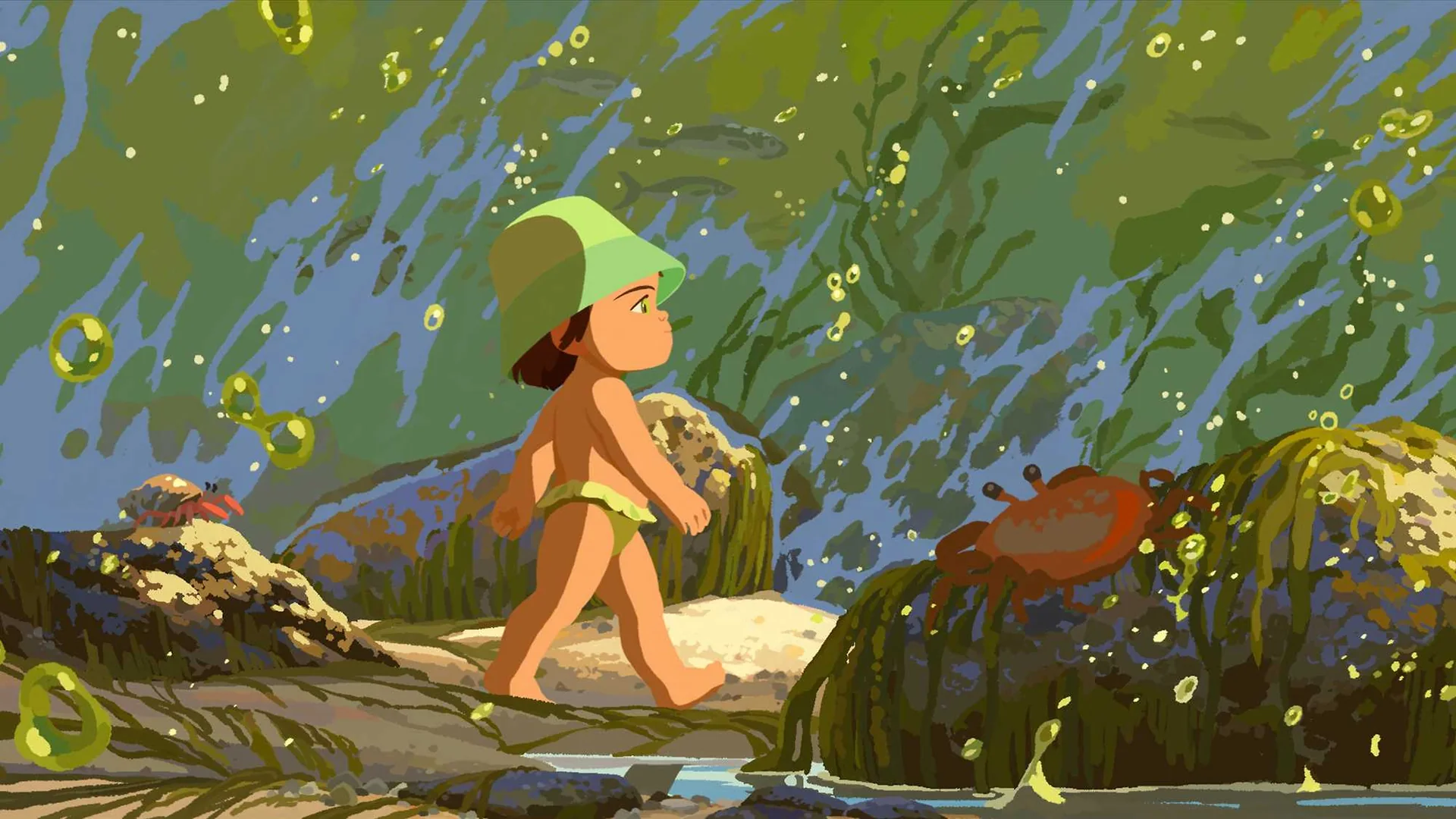
A world begins with a taste
A piece of white Belgian chocolate does more than please a small child. In Wilson Chapman’s IndieWire account of Little Amélie or the Character of Rain, its taste brings an awakening approaching bliss: sensation reorganizes the world. Amélie, a Belgian diplomat’s daughter growing up in 1960s Japan, believes herself divine, but has none of an adult’s understanding of what surrounds her. That mismatch gives the film its subject. The important journey is not simply getting older; it is discovering that a world apparently arranged around oneself contains other people, attachment and the possibility of loss.
Directed by Maïlys Vallade and Liane-Cho Han, the film adapts Amélie Nothomb’s semi-autobiographical Métaphysique des tubes. It is a 2025 production, not a new 2026 film accompanying its forthcoming Hong Kong opening as 愛美麗的奇幻世界. The announced local presentation retains French dialogue with Chinese and English subtitles, distinct from the English dub produced for the US release. These language distinctions sit alongside the story’s own cross-cultural attachment: Amélie’s emotional identification with Japan complicates any simple account of where this Belgian child belongs.
The book they shared
The directors’ first feature grew from a partnership established well before this adaptation. They met as animation students at Gobelins in Paris, then worked on films including The Little Prince and Long Way North. During production of Calamity in 2018, Han passed Vallade Nothomb’s novel. He had first read it at nineteen and recalled to IndieWire that finishing it may have been the first time a book made him cry. Vallade responded to its compact but overwhelming sensory force. Their starting point was both an enduring private attachment and a newly shared discovery.
Both were drawn to the book’s philosophical treatment of early childhood. Their task was to turn that attraction into sensory experience, rather than merely illustrate ideas about consciousness. Their earlier work with Rémi Chayé offered a visual route: simplified, impressionistic drawing could make selected shapes and colors carry the weight of discovery. This connects the novel’s intensity to an animation practice they already knew, without requiring a densely descriptive world. The finished film premiered at Cannes on May 20, 2025, before opening theatrically in France on June 25.
A digital watercolor world
The watercolor impression should not be confused with a documented paint-based process. Vallade’s official project page credits 2D animation made with Adobe Animate, Photoshop and After Effects, with Eddine Noël as artistic director. In the IndieWire interview, Vallade identifies Japonisme—the French engagement with Japanese artistic traditions—as a reference for color and simplification. Han describes an inheritance spanning Disney and Japanese animation, including Studio Ghibli and Hayao Miyazaki. Vallade also looks to live-action cinema for framing and the placement of an imagined camera at Amélie’s perspective.
Those influences become useful when the image changes with the child rather than merely illustrating her surroundings. Chapman describes Amélie’s first spring as flowers expanding into a boundless field; during a near-drowning at the beach, the sea parts. Han links these inventions to her changing emotional state and increasing self-awareness, and traces the beach image to his own mental picture while reading the book. The impossible landscapes are not detachable fantasy interludes. They give scale to feelings that a very young child cannot yet organize into an adult account.
Whose Japan?
Vallade makes a crucial distinction: this is Amélie’s idealized Japan, not an unfiltered representation of the country. Yet subjectivity did not remove the need for historical grounding. Noël researched the Kansai region and the 1960s setting, reconstructing the novel’s house; Western furniture inside it expresses the family’s cultural mixture. Locations including the climactic beach draw on real places, with locally appropriate plants and fish. These details give the fantasy something to transform. The child’s imagination works upon a particular household and environment rather than a generic picturesque Japan.
Writing in In Review Online, Morris Yang reads the film through cultural displacement: race, gender and language emerge as facts Amélie cannot readily understand. His interpretation also follows her imagined godhood toward mortality, through her grandmother’s frailty and her own brushes with drowning. Nishio, her Japanese nanny, offers companionship within that uncertainty. One concrete expression of their bond has another origin: the directors told IndieWire that Nishio making and spinning two tops came from a color artist’s childhood memory. A crew member’s recollection becomes a way for two characters to recognize their connection.
Childhood, sold to adults
The critical responses leave room for different judgments. Chapman praises the film’s unusual ability to convey how a child sees; Yang finds lasting ideas in it while judging parts of the result somewhat slight. International publicity puts greater emphasis on adults recovering their own childhoods. Tian Yuping’s Mirror report, republished by Yahoo under the Taiwanese title 小雨愛蜜莉, describes Nothomb becoming tearful at the premiere and feeling her memories revived. That reported personal reaction is poignant, but it is not the same claim as saying the film works equally on everyone.
World Journal similarly relays Hideo Kojima’s praise for imagery made possible by animation and the rediscovery of fading everyday scenes. Ghibliotheque’s episode listing dated February 13, 2026 places its advertised directors’ conversation among Oscar and BAFTA contenders. In Hong Kong, the adult-memory pitch meets a promotional search for a young Amélie lookalike: Bastille Post reports a competition for girls aged three to six, judged by Louise Wong, with a magazine-cover shoot and premiere invitation promised to the winner. Wong’s promotional comments frame the film as a letter to adults. Parents are invited to revisit childhood, while the announced arrangement has the winner styled as Amélie for the shoot.
The Hong Kong arrival
Bastille Post reports an announced Hong Kong release date of December 3, 2026, listing Edko as distributor, a Category I rating and French dialogue subtitled in Chinese and English. The local listing gives 77 minutes. Yang’s review and the detailed credits on Vallade’s page give 78, while that same official page also has a 75-minute heading. Those figures do not establish that Hong Kong is receiving a different cut. What is clear is the distinction between this local engagement and the film’s original 2025 production and French release.
Vallade’s stated hope is more intimate than the release campaign: to stir memories of being young and of love unhindered by barriers. The two spinning tops give that wish a modest, tangible form. They began in someone else’s childhood, entered Amélie and Nishio’s relationship, and became a shared gesture rather than a philosophical explanation. Their force lies in that passage from private memory to an act of companionship. A film about a child learning to inhabit the world makes room for another person’s remembered childhood inside her own.